Monday, June 2, 2014

9 month anniversary

Palabra del día: Ciao
Translation: Goodbye in Spanish, and hello and goodbye in Italian.  All too appropriate, since I just said goodbye to Granada and hello to Florence!

Comida del día: homemade pizza
Speaking of Italy... actually the pizza we made a few weeks ago would probably not at a high enough standard to be qualified as pizza in Italy, but in my opinion it was pretty tasty.  I also learned that making pizza from scratch is super easy and a great thing to make when you have hardly any food in the house.  For the dough, all you need is flour, water, and some sort of yeast. Or if you can't find any yeast, baking soda seems to work just fine.  And if you can't find a rolling pin, use a zucchini! (it worked perfectly). And then all you need is some combination of veggies and cheese.  We had a pizza making party a few weeks ago and look how nicely they turned out:


Foto del día:
Typical day hanging out in the Party Piso with Alberto and Nabil.  I'm definitely going to miss this!

After nine happy months together, Granada and I had to separate.  It was for logistical reasons rather than relationship problems, and we were both extremely sad about it.  I've cried about 10 times in the last month, and it rained all afternoon in Granada the day before I left, which I like to think was Granada crying for me.  And now I'm in Florence for the next month!  I'm slightly less excited that I should be because this transition is colored by the fact that I'm depressed about leaving the city I fell in love with this year and all of the amazing people I met there.  So far, Florence seems like a lovely city, but it has some steep competition if it wants to try to win my heart. 

Some of you may find it hard to believe that even after nine months in Granada, and five months longer than I originally planned, I still wasn't ready to leave.  Deciding to stay for the full year was definitely the right decision for me and one of the best personal decisions I've made in my entire life.  In fact, I'm fully convinced that spending a year abroad in college should be the norm, rather than the exception.  A semester abroad gives you the chance to travel a lot, party a lot, study a little, learn some things about the culture and maybe have a conversation or two with people who live there.  A year gives you a chance to do all of those things as well as form real relationships with people from other cultures, and for me these relationships were the highlights of my time abroad, as well as where I learned the most.  And although Granada is a pretty small city, I was still discovering new things right up until the very end.  In my last week, I went to a beautiful garden near the Alhambra for the first time and found out that one of my favorite concert venues has jam sessions on Tuesdays which I had been missing all year, but Thankfully I managed to go to one my last week.  So despite its size, Granada is full of hidden places and fun things to do.

A few weeks ago, I was browsing through some old blog posts, reminiscing, and trying not to cry (but yes, I was crying...) and I found the post where I described my decision to stay for the year.  Within that post I had written my goals for the second semester, which were nice to read because I could easily see which ones I had completed and which I hadn't.  The results went something like this:

1. Spend more time with new Spanish friends
I definitely succeeded with this one!  Although I should really edit this goal to "Spend more time with non-American friends".  Last semester I generally ended up hanging out with large groups of American girls, and although this was fun, I loved having opportunities this semester to spend more time with Spanish people and people from all over the world.  My housemate Alberto never hesitated to invite Rebecca and I along to whatever fun event he happened to be going to and for some reason seemed to genuinely want to hang out with a bunch of American girls most of the time.  I also had the pleasure of living with Nabil and half the time his sister Mariam as well, with whom we had some great discussions about current events, Moroccan culture, and anything and everything else (they both love to talk!)   In my last post I wrote about the "international dinner" we had a few weeks ago, and I don't think I've ever been in a room with people representing so many different cultures.  From these people I've learned all sorts of new things, and it's been a wonderful experience to find out how my life is similar and different to people in other countries.  And also of course to learn swear words in a whole variety of languages!

2. Study a bit more
This definitely did not succeed in this one...but no pasa nada (Do you remember this Word of the Day?) The truth is, I learned more from meeting all of the people I mentioned above than I could ever learn in my classes.  And it turned out that my course load was easy enough that I didn't need to study all that much to do well in my classes.  My reasoning for this goal was that after one semester I would be adjusted enough to life in a new country that I could focus more on school.  However, second semester turned out to be drastically different.  I mentioned that my friends were different, but I also had to adjust to living in an apartment, cooking for myself (remember how I struggled to light the stove for a good long while?), making new friends since many had left, and starting a new internship, and I also got the opportunity to explore Granada with people who have lived here for years, so there were tons of new places to discover. All of these adjustments were great because it allowed me to have two very different study abroad experiences from one semester to the next, and in my opinion new experiences are what studying abroad is all about.

3. Take more music classes, learn flamenco guitar, and do an internship: done!

So all in all, two out of three goals accomplished, and I have no regrets about not accomplishing the other one.

I truly cannot believe that the semester is over.  During my last week, I slowly said goodbye to all of the people and places that have become important to me: my host mom, my internship supervisor, my favorite bakery, the people in the band, my friends from the US...and it's scary to think that I have no idea if and when I will ever see these people again.  Although I'm incredibly sad, I've realized that goodbyes often end up being celebrations and can be lots of fun.  For example, at my last band rehearsal Rebecca and I brought chocolate chip cookies and a photo collage with thank you letters, and then afterwards we all went out for tapas, of course.  It's depressing to think that that was the last time I will ever go out for tapas with the band, especially since they've been such an incredibly welcoming community, which is something that is incredibly valuable while living in a foreign country.  But of course while we were out we had a great time with lots of jokes (many at my expense), just like always.

We also of course had to have one last party in the Party Piso, with my housemates and honorary housemates in attendance, a bunch of people from the band, and a few other people who I've managed to make friends with over the course of the year.  This was on my second to last night in Granada.  My last day I spent with my closest friends.  I made lunch for all of my housemates and honorary housemates, giving one last go at cooking Spanish food while Spanish people were around to help me.  I made my host mom's paella recipe and salmorejo (cold tomato soup that's thicker than gazpacho).  Look out for the recipes soon!  Then at night we went to a jazz-themed cafe called Cafe Bohemia, which we seem to end up at every time it's someone's last night in Granada.  I guess even in a year we were able to start a few traditions.

One of the reasons it's so hard to leave Granada is that I made some of the best friends there that I've ever had in my life.  In addition to my friends from all over the world, I also became best friends with Annie, Rebecca and Silvia (three other American girls from my program).  We ended up spending a ridiculous amount of time together due to the fact some of us lived (or practically lived) together, had classes together, did some of the same activities and had incredibly active social lives to fully enjoy the Spanish culture.  By the end of the semester I felt like we were more like family than friends - we even sometimes had "family arguments"!  I think the fact that we were all so far from home also brought us closer together.  Although I loved having friends from so many different cultures, sometimes it was nice to hang out with three other Americans, talk about anything and everything, and feel a little bit more at home.  I've been so many amazing places this year, but even so, some of my best memories are just of hanging out in the Party Piso, playing games, eating, chatting, making jokes and enjoying the opportunity to spend time with good friends.  At WashU, it's easy to get caught up in studying and to-do lists and spending time with friends often gets pushed to the bottom of the priority list.  I've learned this year how important friendships can be and how much I can learn from spending time with other people, and going forward I'm going to try to make that a more important part of my life.
Something I've been wondering is whether I've changed throughout this year in Granada.  This is probably a question that you can answer better than I can, but I'll give you my best guess.  In some ways I think I've changed a lot.  I've had a much more active social life this year, I've loved meeting new people and I've realized the value of the things you can learn from simply having a conversation with someone new.  I've also jumped at many chances to try new things this year, and in some of these cases I might have been more likely to hesitate in the past.  I've realized that trying new things is invigorating and educational, but I certainly haven't left my old logical self behind who always thinks before she acts.  And then there are the little things that have changed: I've completely adjusted to the Spanish eating schedule and I love taking an afternoon siesta.

But I've also realized that I have certain core values that will always stay the same, and these values stick out even more when I'm in a completely new setting.  For example, I was worried that I wouldn't have time or resources to play music while in Granada, but I ended up spending lots of time playing music and meeting friends through playing, just like I've always done.  Playing music is something I love to do and if it followed me to Spain, it makes me think it will follow me for the rest of my life.  Another thing I've noticed is that although my social life is more active here, I still need time for myself.  My WashU friends always make fun of me because I go to bed early, and my friends here are always convincing me to stay out later (although at WashU "early" means midnight, and in Spain it usually means 3 am...)  But in the end, I'm still the same person, and I still need my eight hours of sleep every night.

One last beautiful view
Throughout this last week of saying goodbye, many people said to me that I could always return if I wanted to.  That seemed unlikely to me - the US is very far away from Spain and I have no idea when I'll be back.  It also didn't help much to think I could return, because I know that if I return many of the people I've met this year probably won't still be there.  However, as my plane was taking off from Granada and I looked at one last view of the mountains and the olive trees that make up the beautiful landscapes of Andalucia, I realized that although I don't know when, I will definitely be back someday. But for now, all I can say is ciao, Granada, until we meet again.

Thursday, May 29, 2014

Why is Granada so beautiful?

Palabra del día: Llorar
Translation: to cry
It's not going to be easy to leave Granada in three days... I've already cried about it six times!

Comida del día: Quinoa lentil salad.  A variation on this recipe: http://www.nomsforthepoor.com/2014/03/jerusalem-inspired-quinoa-salad.html
This is definitely one of the highlights of things I've cooked this semester.  Although as the semester got busier, I started surviving on a lot of pasta, eggs, sandwiches and salads, so maybe it doesn't have that much competition?  Either way, it was absolutely delicious.  I had lots of lentils so I used those instead of chickpeas, and I also skipped out on some of the herbs.  I did use cilantro which made it super yummy and gave me an excuse to make lots of guacamole the next day to use up the extra.

Foto del día: 

One last Alhambra photo.  Are you sick of looking at it yet? I'm definitely not.  I took this photo after a wonderful day of hiking on the paths above the Alhambra with my friend Rebecca.  I also discovered a new garden next to the Alhambra that had towers, ducks and beautiful views.  It's hard to believe that there are parts of Granada that I still haven't seen after all of this time!
I'd like to start by sharing two "Only in Granada" moments that I experienced within hours of each other last week.  First, I went to an end of the year party at the elementary school where I did my internship and there was a bar with beer on tap set up on the patio.  Can you imagine a bar with alcohol at an elementary school party in the US?  Only in Spain.  The second moment was later that day when I went for a run and saw a man just casually riding his horse down the street.

I have three days left of my year in Granada, and I'm not at all ready to go.  But I'm going to avoid that subject for now (look out for another blog post in a day or two about that depressing topic) in order to update you about all of the recent fun activities I've been up, since I've been fully taking advantage of my dwindling time in Granada by enjoying my time with the beautiful weather, landscapes and people that I'm so sad to be leaving.  Here's the highlights of the last month, summarized into a nice bullet-pointed list with plenty of photos to facilitate easy-reading and avoid the boredom that is often caused by reading trivial details about someone else's life:
  • My theater class went to a puppet show in the puppetier's a small pueblo (village) called Conchar, and first we got to walk around, enjoy the views, and pick oranges off of trees. 
                                               
  • Finally went to a Spanish fútbol game! Granada lost, but it was still fun, and we could see the mountains from the stadium!

  • We had a four day weekend and for once I wasn't traveling, so I took a "staycation" and went on a few day trips.  First I went to a town called Quentar and hiked to a giant reservoir, then swam to a cave, then hiked back.  What an adventure!   I also went to a town called Guadix which has a very large neighborhood in which all of the houses are built into caves.  Unfortunately, there wasn't much else to see in Guadix and we had to kill three hours in cafes waiting for our bus home.  The third day I spent at the beach, and the fourth day was a festival in Granada called Día de las cruces (Day of the crosses) in which the whole city was out on the streets and many patios were decorated with flowers and crosses on display.
The cave that we swam to at the Quentar reservoir.

Decorated patio for the Day of the Crosses
  • We had an international dinner in the Party Piso, with people and food from Spain, Morocco, Italy, the Czech Republic, the US, Mexico, Armenia, and I'm probably forgetting somewhere!  It's been an amazing experience to make friends this year with people from so many different cultures.
My friend Anna from the Czech Republic made a wide variety of delicious cookies which she said she always eats at Christmastime.
  • I went on the IES field trip to Cabo de Gata, which I had done last semester as well, but this semester we went for two days instead of one.  The first day was a long hike and the second day we spent relaxing on the beach, doing yoga, and kayaking.  And I was thrilled to get the opportunity to look at this view again! 

  • I also went hiking one weekend with my friend Silvia, my internship supervisor Carlos, and another teacher from the school where I did my internship.  The hike was beautiful, of course. 


  • While on the hike, we started talking to Carlos about the pueblo where his family lives, and then he mentioned he was going there that very day and invited us to come along!  Of course we took him up on the offer.  The pueblo is called Iznájar and is about an hour from Granada.  It is definitely the most beautiful pueblo I have seen in this area.  It has the biggest reservoir in Andalucía and is surrounded by olive trees, with the main part of the town built on a hill and consisting of the typical small white houses that are in many of Andalucía's hill towns.  Carlos was incredibly generous to show us his home and introduce us to some friends and family.  Our first night there we watched the sun set over of the reservoir, and the next day we hung out on the beach, went kayaking, and went for a walk to see gorgeous views of the town and the reservoir.  Before visiting Iznájar, I couldn't understand why Carlos would leave Granada every weekend to go home to a tiny pueblo, but now I'm incredibly jealous that he has the opportunity to be in such a beautiful and relaxing place so frequently and I've been wishing I could go back.


Spending time with Carlos also gave us a chance to talk about our internship experiences and the Spanish education system in general, since in the midst of all of these fun activities and beautiful views, I also managed to finish up my classes and my internship, take exams, and write final papers.  It still amazes me how little I've had to study this year, and I know that with my full WashU course load next year I'm going to be in for quite a shock.  Even so, I still managed to learn a few things in my classes, especially about the Spanish education system.  With my internship, I got to see firsthand how an elementary school works here, and I also had the opportunity to take two drastically different classes at the University of Granada.  I didn't notice too many differences between elementary schools in the US and Maristas, but I did learn that the options for schooling are a bit different.  Just like in the US, there are private and public schools, but Maristas falls somewhere in between: it is funded by both the government and a private foundation, in this case a religious one called the Maristas Brothers, so some of the teaching ideology is Catholic.  Within the school, one of the biggest differences I noticed was that when teachers give feedback to students, they often say, "Muy mal!" ("Very bad!"), which is the kind of feedback that in the US would have kids crying and parents on the phone to the principal.  This probably fits in with one of the cultural differences I've written about before, which is that Spanish people tend not to sugarcoat things - they tell it like it is, and apparently this starts at a young age.

I also learned about the Spanish education system through my music education class at the University of Granada.  This class was actually a bit of a joke: we had hardly any work and therefore I barely learned anything, although this was partly due to the fact that the people in the class didn't know anything about music, so the class focused on learning basic music rather than learning how to teach music, which is what I had hoped to learn.  I was confused why this class ended up being so much easier than the music history course I took last semester, and it turns out that classes vary widely depending on what school they are in: the history course was in the school of Filosofía y letras (history, literature, etc.) while the music education course was in the education school.  Apparently, Spanish students take exams in the middle of high school, and their scores on these exams affect which school they are allowed to study in for college.  For example, people with the highest scores can study medicine, and people with lower scores can't.  The education school has some of the lowest score requirements, so the students end up being less bright and the classes less challenging.  In my opinion, it should be the opposite: we need smart teachers to teach the next generation because they create the future.  But apparently teaching is not highly valued, similar to the US where although we don't have exams to determine who can study what, people are often deterred from teaching because of low salaries, and being a teacher is generally not considered one of the most highly respected professions.

So although my classes weren't all that challenging, I enjoyed the opportunity to learn firsthand about the Spanish education system and to experience a university class that was the complete opposite from my class there last semester.  After having both of these experiencies, it makes me think that there has to be a middle ground somewhere... but I think I'd rather go back to taking WashU classes, despite all of the hard work that is necessary, than attempt to find a class that suits me at the University of Granada.  My internship also helped me to think about whether teaching is something I would like to do in the future.  I enjoyed spending time with kids, although I realized that in terms of teaching I would rather teach older kids (I worked mostly with first and second graders) so that I can focus more on the material and less on behavior.  The two music classes I helped out with were definitely my favorites, so it was nice to learn that teaching music is something I enjoy.  In addition to teaching, this year abroad has also caused me to consider ethnomusicology as a career option, since I've loved learning about Spanish music through playing in the band and taking flamenco guitar and dance lessons.

  • Annnddd finally, one more day trip: my friend Annie left last Sunday (sob) and before she left her parents came to visit for a few days.  They rented a car and my friends Silvia, Rebecca and I got to go with them on a day trip to the Alpujarra mountain towns and then back to the Quentar reservoir.  Yet another opportunity to enjoy the beauty of Southern Spain, with some great friends.  These are some people that I am definitely going to echar de menos!


Monday, April 28, 2014

Semana Santa

Palabra del día: Muerta
Translation: Dead
Why such a morbid word for a post about celebrating a holiday?  Because after playing in processions three days in a row for 6-8 hours each day, I was completely muerta.  Also, if you think about it, Easter celebrates the death of Jesus, so it's really quite appropriate.

Foto del día: 
My bananagrams-style summary of my experience during Semana Santa, which I made during an end of the week celebration in which about half of the band ended up at the Party Piso.  Translation help: tuna sandwich, beer, Armilla band, muerta, Party Piso, procession, virgin
Comida del día: The Semana Santa holiday of course comes with some special treats.  I of course made sure to show Caroline my favorite bakery in my old neighborhood, and we tried torrijas while we were there.  Torrijas are the Spanish version of French toast, made  of bread dipped in eggs and milk, fried, and then drenched in honey or cinnamon sugar. ¡Que rico!


Last week, I had the opportunity to participate in probably the most unique and bizarre traditions of southern Spain: the religious processions of Semana Santa.  In Southern Spain, every day of the week leading up to Easter is a holiday, celebrated with constant religious processions in every town and neighborhood, all day long and late into the night.  Before Semana Santa, people in the band warned me that: 1) I would be muerta afterwards, and 2) I would decide that Spanish people are crazy and want to leave Spain immediately.  I didn't believe them at all, but in the end, number one was 100 percent true and number two, 50 percent - I've decided that Spanish people are crazy, but that still doesn't make me want to leave!

Before I describe my own experiences with the Semana Santa processions, I'm going to do my best to explain how they work, although it's a difficult concept to understand and even after playing in three I'm still unclear on certain details.

The processions are basically parades in which the focal point are statues of Jesus and of the Virgin Mary, called pasos.  

Jesus paso

Virgin paso

The order and components of the processions vary depending on the size, but the ones I played in went something like this:
  • Led by someone carrying a cross
  • Followed by a penitentes, or people repenting their sins and mourning the death of Jesus.  These people wear costumes that look exactly like the costumes of the KKK (sometimes white and sometimes other colors), but the similarity is purely coincidence and has no historical relation.  The point of these outfits is to hide the identity of the penitentes, and the pointy hats represent rising toward heaven.  Although I knew that there was no historical relation between the KKK and the penitentes, I still got a bit of a shock every time I saw the outfits.  It was interesting to view something that I've always associated with a horrible part of American history in a completely different context.

  • Followed by people carrying candles and incense
  • The Jesus paso, weighing up to one ton, carried from beneath on beams by a group of up to 50 tough guys called costaleros, which means that they wear sacks on their heads.  The fact that the pasos are so heavy and so large (and oftentimes have to be manuevered through small streets and around narrow corners) means that the processions move slowly, stops frequently, and that the band members have very tired feet.
  • A loud brass band, with lots of drums and trumpets, colorful suits, and funny hats with feathers sticking out of them
  • More penitentes, candles and incense
  • The Virgin paso
  • And finally, the Banda Musical San Isidro de Armilla (AKA, me!)
About to start playing (especially Alberto!)  Look how many of us there are, squished by the crowds on the sidewalks, in our snazzy suits and ties.
The processions are organized by cofradías, which are organizations that devote themselves year-round to preparing for Semana Santa.  It's important to distinguish between the religious aspects of the holiday and the traditional and cultural aspects.  Although the processions are for religious reasons, the fact that they for the most part only exist in Southern Spain makes them an incredibly unique part of the culture.  That being said, participants in Semana Santa are not necessarily the most religious people.  Cofradía members might just like the culture and tradition and want to belong to a group, costaleros probably just want to show off their muscles, and band members are motivated by a love of music, some money, and of course a cerveza after the fact.  The other aspect of Semana Santa nowadays is tourism.  Granada was overrun with tourists trying to view the spectacle, and in the meantime Lisbon was overrun with Spanish people on vacation, trying to escape the tourists who had invaded their homes and the streets blocked by processions preventing them from going anywhere.  So although some Spanish people love this culture and tradition, many do their best to avoid it completely.

Ok, back to the processions.  Once all of these components are in order, what happens?  First, everyone leaves the church.  If the paso is too tall, oftentimes the costaleros have to go through the door on their knees while carrying the giant, heavy statue on their shoulders.  Once the paso makes it out of the church, the band plays the Spanish national anthem (and I pretend to play the national anthem because everyone in the band has it memorized and no one thought to give me music for it).  Then we start walking on some indirect route toward the cathedral while spectators (mostly small children, tourists, and frustrated residents who are just trying to get home and are regretting ever trying to go anywhere during Semana Santa) push each other to try to get a better view.  We stop frequently and walk very, very slowly.  Marches played by the band are interspersed with saetas, or sad, chant-like songs usually sung by one person.  Once at the cathedral, the paso goes through it and the band walks around the outside, drinks a lot of water, and continues on its way on some indirect route back to the original church, where the paso is returned to its home with another round of the national anthem.  A procession route that would take 15 minutes to walk at a normal pace takes about six hours during the procession.  The processions I played in were 6-8 hours long and ended between 1 and 3:30 am, but apparently these were on the shorter side as far as processions.  We passed one procession that left at 6 pm, went all the way to the Abadia de Sacromonte (a half-hour hike that I did with my mom), and arrives at 6 am.  I can't even imagine.

Each procession is different depending on the days of the week.  The Wednesday, Thursday and Friday processions that I played in were the longest and most important ones, and Thursday is the most important day of the week since the processions end in the very early morning of Good Friday.  The procession I played in on Thursday was called the Aurora.  In this procession, the Aurora statue of the virgin comes down from the Albeyzin neighborhood, which is hilly with narrow streets and beautiful views of the mountains and the Alhambra.  It arrives at the cathedral where she is coronated, and then starts the long journey back to the Albeyzin.   This procession was the longest that I played in: it started at 7 pm and ended at 3:30 am, but even this late at night there were still lots of spectators who followed us back up the hill.  There is a chant that goes along with this procession in which someone yells "Aurora" and everyone yells back, "guapa!" (translation: beautiful), and we had to listen to this chant for eight hours.  My roomate Nabil annoyed me for a week following the procession by yelling "guapa" constantly, bringing back memories of aching muscles and extreme exhaustion.  However, when we finally arrived at the church, rose petals rained down as the Aurora statue was returned, and even in my physical state of aching lips,  dehydration and hunger, I was still able to appreciate the beauty of the moment.  That was just one moment in eight hours though...When the procession finally ended the cofradía was nice enough to give us tuna fish sandwiches, and I think it was the best tasting tuna fish sandwich I have ever eaten.  

Here's a video of the Aurora being returned to the church at 3:30 am at the end of the procession.  Listen for the "Aurora, Guapa" chant at the beginning, see how beautiful the statue is all lit up, and get an idea of how slowly these processions move, since the band doesn't start playing until 3 am.  Also, give us a break: we sounded a lot better at the beginning of the night!  The video focuses on the Aurora statue and not the band, since obviously she's the star of the show.


Visit this page for tons more videos:
https://www.facebook.com/pages/Aso-Musical-San-Isidro-de-Armilla/1467886550102694
Also, give it a "like"!  I'm on a mission to bring the band some international recognition.

After the Aurora procession, I went home convinced that by body would never recover and swearing that I was never going to play in another procession, despite the fact that I had promised to play in one the next day.  However, somehow I let myself be convinced to go (helped by the fact that I live with Alberto, who was also playing, and he probably would have dragged me there if he had to.  I'm proud to say it didn't get to that point!)   Everyone in the band was impressed that I had returned for a third day in a row, although possibly also slightly confused about why a foreigner would ever want to do that.  The Friday one was only six hours long and despite my aching muscles, it felt much easier compared to the one the day before.  I also had a few groupies in this procession in the form of friends who brought me food and water, who are also the source of all of the photos in this blog, since I obviously had my hands full of French horn the entire time.

I actually managed to smile in this one, despite aching muscles!
My friend Caroline, who came back to visit Granada with me after our trip to Lisbon, won the prize for the best groupie.  She followed the entire six hour procession on Wednesday (and of course easily made friends with a few band members) and then came back to watch part of a second one on Friday. 

I'd like to share some thoughts that were going through my head during these ridiculously long period of standing, walking and playing French horn:

What song are we playing now? How do I switch my music while holding my French horn? This music stand is attached to my horn with a hair elastic and is definitely going to fall and spill my music all over the place.  Why am I wearing a tie?  This suit they lent me is three sizes too big.  We're moving soooo slowly!  Water? Food? When can I sit down?  I think I've been passively converted to Catholicism.  The paso is actually quite beautiful with all of the candles.  That small child just yelled my name but I don't know who she is.  Spanish people are crazy; how do they do this every day of the week year after year?  Thank god I'm getting paid.  I hope I get paid a lot.  I wish someone would come carry my French horn for me.  The cathedral is so beautiful all lit up!  I think I'll just pretend to play this march.  No, if I keep playing it's easier because it distracts me from my aching muscles.  Only...three hours left, ahh!  There's absolutely no way I'm going back tomorrow.  It's ok, at the end they give us sandwiches. 

So why did I devote half of my vacation week to celebrating another country's tradition that involved some serious physical labor?  The truth is, despite all of the hard work, I thoroughly enjoyed myself.  The members of the band are such a great group of people, and of course joked around the entire time ("When do we get our sandwiches?" "The next time we stop, let's go into a bar to get a beer."  And of course the classic, "Do you have a Spanish boyfriend yet?  Does your friend have a boyfriend?")  They were also incredibly sympathetic about the fact that it was my first time playing in a procession, constantly asking how I was doing and giving me words of encouragement.  

I also appreciated the opportunity to be able to fully participate in this unique tradition, as crazy as it might be.  I probably would have enjoyed the beauty and emotional impact of the processions more if I had been watching rather than participating, but by playing with the band I got the chance to participate in Semana Santa like a local, and that's more that I ever thought I would get out of my study abroad experience.  I'm so grateful to the members of the band for welcoming me into their community, treating me like one of them, and giving me so many incredible opportunities.  And although I joke about how horrible certain parts of the Semana Santa experience was, my firsthand participation in this tradition is something that I will remember forever.  My band friends joke about how horrible certain parts of the week are, but they still come back and play year after year.  Despite my extreme exhaustion, I was still able to appreciate certain beautiful moments of the processions, and although I do think Spanish people are crazy, I feel like I now have an understanding of the cultural importance and devotion that so many people value in this tradition.  

Obviously I could have watched more processions on the days I wasn't playing, but I was so sick of them at that point that I did everything possible to not have to hear any more Spanish marches.  Instead, I got to show Caroline around Granada and go on a picnic and yet another secret spot that Alberto was nice enough to take us to:

View from the Albeyzin neighborhood, and Alberto surrounded by chicas, like always.
That's the real beauty of Granada.  I can be surrounded by crowds of tourists, relgious processions, and a giant cathedral, walk 10 minutes outside of the city, and find myself surrounded by nature and people who live in caves.  With only one month left here, I can't help thinking about how much I'm going to miss this city.  


Monday, April 21, 2014

Good food, good wine and good beaches

Palabra del día: Soldad
Soldad is a Portuguese word that expresses an emotion of missing someone you love.  It is oftentimes sad but not always, and according to a knowledgable tour guide, any definition that is less than three sentences long is inaccurate.  This word is relevant because it is the emotion behind Portuguese folk music, called fado. 

Comida del día: Pasteis de Belem
These delicious cream tarts are famous in the neighborhood of Belem.  We each ordered one, and they came out warm, with a flaky crust and a creamy, sweet filling... we couldn't resist ordering another one!


Foto del día: 
View of Lisbon on a foggy morning.  Thankfully it was sunny every afternoon!  Red roofs, big hills, and is that bridge in the distance the Golden Gate Bridge? No, but it was built by the same company and looks exactly the same.  Lisbon even has cable cars, just like San Francisco.

Another blog post about yet another European city...this is starting to feel a bit too routine!  I still haven't quite recovered from those six weeks of traveling over winter break, so when I left for Lisbon I was already feeling a bit worn out just from the thought of living out of a suitcase again.  But something about having four days to relax in this charming coastal city, with its beautiful blue tile-work, charming hills and cable cars, long walks along the ocean, and scrumptious wine and pastries, made any reluctance to travel disappear immediately.

I went to Lisbon with my WashU friend Caroline, who is studying in Madrid this semester.  I had never traveled with her before, but we turned out to be excellent travel buddies.  It helped that we both share a strong passion for food!  So I'll start with the food.  We ate so much good food.  Portuguese food is like Spanish food but with more butter and tons of fresh seafood.  I'll resist describing every meal and just give you the highlights.  Pastries, obviously.  In addition to the cream tarts, I ate the best chocolate cake I've ever had in my entire life, but we had to search for it a bit after reading about it on Caroline's TripAdvisor app.  We finally found it in the LX Factory, which is a factory converted into funky shops and cafes.  The cafe with the chocolate cake literally only sold chocolate cake and coffee drinks.  It was the perfect texture and combination of cake and frosting, I could tell that the chocolate was top notch.

Also in the LX Factory, we found this giant bookstore, full of plenty of corners to snuggle up in with a good book, and also including a cafe, concert space, and a really cool bike statue hanging from the ceiling.  


Back to the topic of food (don't worry, I'm almost done).  The best meal we ate was at a restaurant that we passed on the way down from seeing a castle, called L'Petite Cafe.  We were on our way to buy a picnic, but our hungry stomachs and the jars of sangria on the patio tables made us stop. Thank god we did.  We ended up chatting and eating on that patio for three hours with our jar of the best sangria I've ever had, and even went back to that same restaurant two nights later.  It's so nice to be on vacation!  Here's what we ate: 
Salmon salad (much fancier than we were expecting!)

Octopus rice. There's tons of seafood in Lisbon and octopus seems to be really popular.  The next day, Caroline ordered a whole octopus at a restaurant!  I was very impressed.  I did try one tentacle, and it tasted like butter.  Yum!
So yes, we ate a lot.  But moving on to the next important thing, we also saw some great music.  One night we went to one of the oldest jazz clubs in Europe.  The music was great, although the venue was nothing special - the original building had been destroyed in an earthquake that destroyed much of the city of Lisbon in 1755 and was rebuilt recently.  Another night, we went with a group from our hostel to see a fado show, which is Lisbon's folk music centered on the emotion of soldad.  We went to a bar where locals go just to sing for fun, basically like a fado jam session.  It felt very authentic and I could definitely feel the strong emotions in the music, which in some ways was similar to the feeling of suffering which is often present in flamenco.  In fado, they use the Portuguese guitar:

I had never seen one before and I learned that each string is doubled to give the instrument a more metallic sound.

When we weren't seeing concerts in the evening, we went to Barrio Alto, which is Lisbon's top neighborhood for nightlife.  I had never seen anything like it before.  It was up a big hill (like most things in Lisbon), and consisted of blocks and blocks of bars and crowded streets.  Everyone would get their drinks in plastic cups and then just stand on the street socializing and people watching.  

In addition to eating and nightlife, we made sure to see all of the important tourist attractions as well.  Highlights include the Belem neighborhood, where in addition to eating pastries, we also went to a beautiful monastery, a free modern art museum, the maritime museum, a tower to climb up and look at the views, and a nice walkway along the ocean. 

One of the many boats at the Maritime museum, which focused on Portugal's history of world exploration and discovery. 

We also went to the Castle of San Jorge, an Moorish castle which of course didn't compare to the Alhambra but gave us a chance to see some great view of the city.  Lisbon isn't all that big, and we were there for four whole days, so we had a chance to do a half day trip to the beach and a full day trip to the town of Sintra.  It was so nice to relax on the beach, and Caroline even went in the water!  It was a bit too cold for me but I did enjoy the sunbathing.  The day trip to Sintra was gorgeous.  We walked through a colorful castle with lots of interesting tile work, then walked through the park surrounding it to see a beautiful view of the castle from afar. 

Tile work on the castle walls

Got some Spanish tourists to take a photo of us

Hiked down the hill from the castle then back up a neighboring one, and we were rewarded with this view!

Then we continued to trip to see a garden that was designed by a renaissance man to represent an escape from hell, and included pitch black tunnels and a really tall well.  

Really tall well (from the top) 
We finished the day at Cabo de Roca, the western most point in Europe.  There wasn't much to do there besides take photos, but it was definitely one of the better places to take photos:


Lisbon felt similar to Spain in terms of its schedule, food, and relaxed lifestyle, and the language, which is of course very similar to Spanish.  Caroline and I found that we could understand about half of what we read in Portuguese and about nothing when people spoke to us.  Thankfully there were lots of Spanish tourists who we could talk to who were taking a vacation to escape the craziness that is Semana Santa in Spain, although Caroline and I returned to Granada in the middle of the week to participate fully in that craziness.  I'm still gathering my thoughts about the Semana Santa experience, which turned out to be much less relaxing than the Lisbon experience, so keep your eye out for an update soon!  In general though, I loved Lisbon as a chance to enjoy beautiful views and some time by the ocean in a city that isn't overrun with tourists or tourist attractions and maintains a lot of local charm. 

Wednesday, April 9, 2014

Guest blogger: guess who?

Palabra del día: Madre
Translation: Mother
In honor of my mom, since we just got to spend a fantastic week and a half together exploring southern Spain.

Comida del día: Spanish spinach and chickpeas
Mom and I cooked this dish for dinner one night for my housemates and other friends, and it was a big hit.  It's my new favorite recipe: easy, simple, nutricious and delicious.  I used this recipe from one of my favorite food blogs, with the idea that I might have more luck with an American recipe after the almost disaster with the lentils.  I was also a bit lazy and skipped the step that says to put it in the oven - I just left it on the stove for a bit longer and it turned out great.  Enjoy, or as they say in Spain, ¡que te aprovechas!

Link to recipe: http://www.biggirlssmallkitchen.com/2009/05/big-girls-global-kitchens-spain.html

Foto del día: Me, Mom and the Alhambra.  What could be better?


And now to introduce our guest blogger: mi madre!  I loved reading about her experience as an informed tourist in the city I've been living in for 7.5 months now and hearing what she thinks about my life here, and I'm sure you will too.


Old…and Young in Granada

What a fantastic opportunity I had to visit and explore Granada and parts of southern Spain with Sarah.  There is something to be said for experiencing life in a new city via those who live there – you see things differently than you would as a tourist, you visit hidden areas, and you experience life as a resident. I came away from my ten days in southern Spain with a renewed appreciation of why Sarah decided to stay the year.

Granada:
As clichéd as it seems, one of the first things that struck me about Granada is how old it is.  On my first afternoon in Granada, we walked along Paseo de los Tristes, gradually climbing to Carmen de la Victoria (a garden owned by the University of Granada) and then to the San Nicolas viewpoint to catch my first views of the Alhambra, the magnificent Moorish castle built in the middle ages, still creating an imposing feeling centuries later. The Alhambra, along with the Cathedral in the center of Granada with its splendid Renaissance architecture; the Madraza – the first Arab university in Granada in the mid-1300s with a stunning prayer hall; and the up-and-down of the Albaycin hill area provide anchoring points for the city today.  As you walk you face centuries-old history, relics of religious conflict, and magnificent architecture reflecting the city’s past.  Suddenly, Boston no longer feels old, charming or laden with history!

During my four days reserved for seeing Granada, I had the pleasure of mixing traditional tourist attractions with some hidden treasures recommended by Sarah. Everyone who passes through Granada visits the Alhambra and it is not to be missed; a morning spent wandering through the castle, gardens and watchtower allows you to envision what life was like centuries ago. This magnificent and majestic structure, with all its grandeur, can be seen from so many vantage points throughout the city.


Some other highlights included:

  • A walk through the Realejo neighborhood where Sarah lived last semester with her host family. We saw great graffiti art and views of the Alhambra from “the other side”, culminating in a two-hour coffee with Sarah’s host-mom, Sole, during which Sarah so ably translated from English to Spanish and Spanish to English that I decided she is fluent in Spanish! Upon leaving her host-mom’s house, we went to Sarah’s favorite bakery that produces fresh-baked and warm croissants, empanadas and other pastries every evening between 5pm and 8pm – yum!


Beautiful apple tart that Sole prepared for us.

  • A tour of Manuel de Falla’s house (Spain’s most famous early 20th century composer), where Sarah was given the opportunity to play his piano – so cool!


  • An afternoon of pampering at the Arab baths where we went from the cool to the warm to the hot rooms/water, and fit in a massage as well. Skin so soft days later! I already knew about the different rooms in the baths and the traditional openings in the ceilings, as we had visited the old baths during our wanderings – Sarah’s Islamic architecture class came in handy.

  • A private tour of the Madraza, the old Arab university built in the 1300s, with a cobblestone street from the 1100s displayed as part of an archeological find.
  • The Cathedral, Royal Chapel and Museum complete with the tombs of Isabel and Ferdinand, the Bib Rambla plaza, the corral de carbon (old silk storage area), and Lorca’s garden.
  • A wonderful hike up to Sacromonte with incredible views of the entire area including the snow-capped Sierra Nevada mountains.


  • The food, because you cannot be with Sarah for more than a day without focusing on food! She made sure that I tried: many different tapas places, churros con chocolate (fried dough dipped in warm chocolate), ice cream at Los Italianos (the famous gelato store in Granada) where I identified the previously unidentifiable flavor in her favorite ice cream cake/cone as orange, pastries from her favorite bakery, and tomatoes on toast for breakfast. We had good meals in several different restaurants including lunch at a Moroccan teteria, and coffee at a bookstore/cafe.
Moroccan food and tea in a teteria.
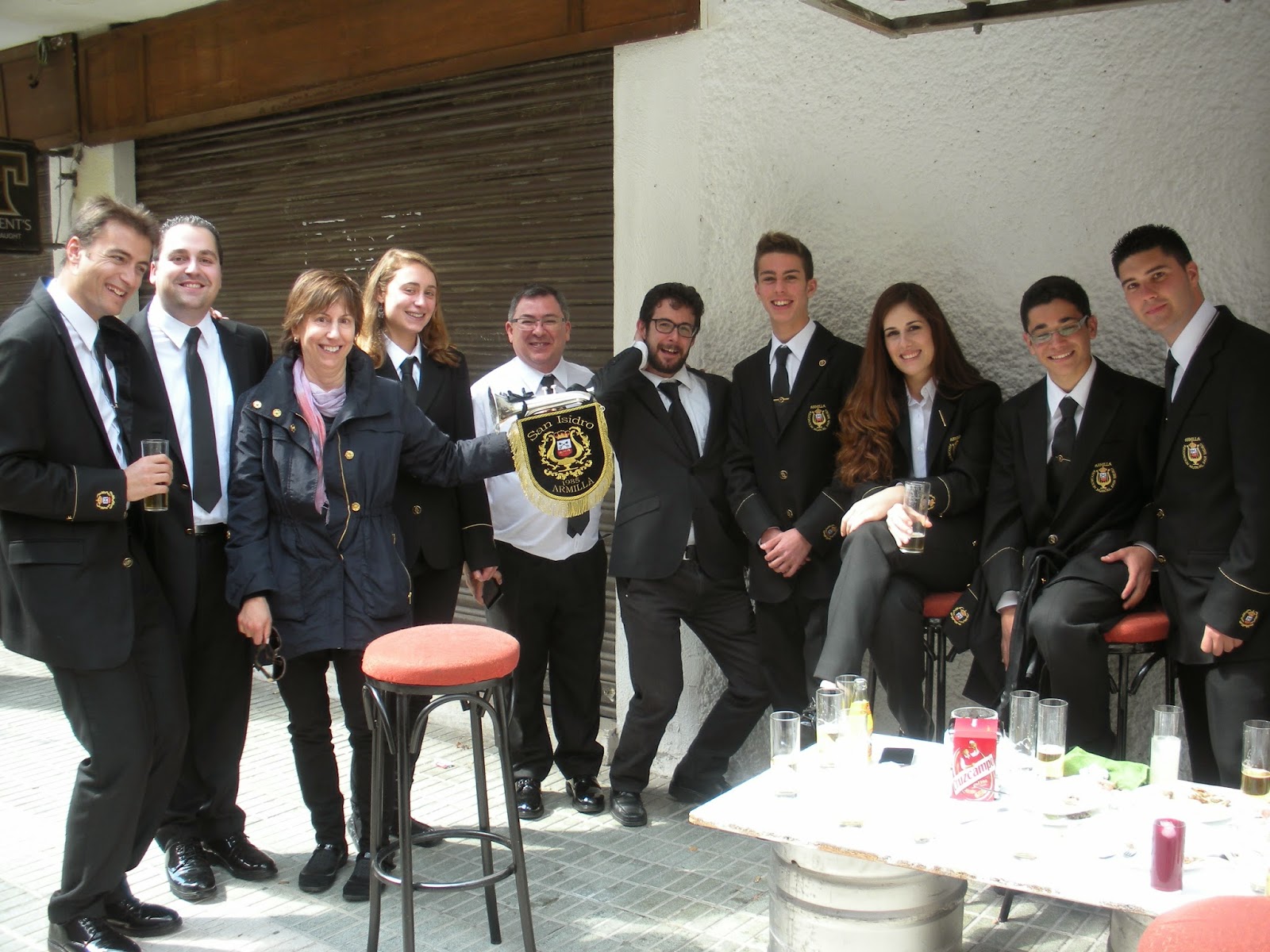
Sarah assured me that the highlight of my visit would be her band concert, which I joked about before I left for Spain. As it turns out, she was right! The Asociacion Musical San Isidro de Armilla brings together high school and university students and adults to form a vibrant and talented community band, based in Armilla, just a bit outside of Granada. Their focus this winter and spring was to prepare the marches for Semana Santa, holy week (beginning on Sunday, April 13), during which they will play and march in religious processionals, six to eight hours a day, most days of the week. Knowing nothing about religious processionals and marches, I expected the typical marches associated with bands in the United States. But, these marches are nothing like that but rather are passionate and emotional marches that I am sure will be augmented with even more feeling when coupled with processionals during Semana Santa. I was treated to an afternoon of tapas and drinks with some of the band members; they often get together after performances or practice to hang with their friends and relax. Antonio, one of the band members, told me that relaxing with family and friends is so important that he cannot imagine not doing it, regardless of what else is going on in his life. Ah, the Spanish lifestyle!

Tapas with some members of the band after the concert. 
The second highlight of my visit was meeting Sarah’s friends and roommates.  And this is where the “young” of the blog post title comes in. In an earlier post, Sarah described the “fun and games in the party piso”; and yes, indeed, that’s what happens in Sarah’s apartment with Sarah, Rebecca (an IES student who also stayed for the year), Alberto and Nabil as roommates; and often joined by Annie and Silvia (two other IES students who stayed for the year), and Esmerelda and Mariam. It doesn’t look like anyone does much work but they sure are having fun!  Sarah made a great dinner one evening (a Spanish chickpea, spinach and tomato dish) and we hung out and chatted in Spanish and English (for my sake).

Sarah is an anomaly in Granada, and that’s apparent pretty quickly. On top of being an American (and American students are pretty easy to pick out even in this city of 80,000 students), she truly doesn’t look like she belongs – her coloring is wrong (there are few light-haired, fair-skinned Spanish people in Granada); she spells her name with an “h” at the end which no one understands because every letter in Spanish makes a sound (when she tells people that her name is Sarah with an “h”, it comes back Sarha); and she puts up with endless teasing (especially from her band friends) about being a vegetarian in the land of jamón. But, Sarah has a great attitude about sharing who she is with her new friends.

Other Cities in Southern Spain:
We spent a few days in Sevilla and Cordoba, both of which I loved. In Sevilla, we walked along a beautiful river and took a rowboat out for a spin in a park (thank goodness Sarah could steer, thanks to her recent rowboat experiences in Madrid), were impressed by the cathedral (wow!) and the Alcazar castle with incredible gardens, and saw a traditional flamenco show (ole!). 

Next to the Granada section of the Plaza de España in Sevilla.

Traditional flamenco show
In Cordoba, we found the Cathedral/mosque to be incredible with the cathedral having its own delineated space within the mosque, and the bridge over the river was beautiful.  In both Sevilla and Cordoba, we did walking tours of the Jewish areas and it was truly sobering to realize that the entire vibrant and thriving Jewish population of Spain was obliterated during the Inquisition; the statue of Maimonides in Cordoba is a wry reminder that the most important Jewish philosopher of all times lived in a city with little religious tolerance or respect. In our wanderings through southern Spain, I was haunted by the obliteration of the Jews; you know that it happened, but actually seeing where it happened provokes a sobering reaction; there is one synagogue left in Cordoba and two in Toledo (Sarah has seen all three) from the time when Jews lived in those areas.

Maimonedes statue in Cordoba
We took  a two-day trip to Nerja, a beach community close to Malaga, and had a wonderful time walking along the beach, eating paella at a restaurant on the beach and enjoying warm weather. We agreed that Nerja is probably awful in the summer, overrun with tourists from England, and not a particularly nice beach when crowded. Two side trips to the Nerja caves and the hill town of Frigiliana were more-than-pleasant surprises – much better than we anticipated and we highly recommend them, especially Frigiliana which has beautiful views throughout the town.

View of the Nerja ocean.

View of the hill town Frigiliana

Sarah kept asking me whether Granada was my favorite city of the trip. How could it not be with Sarah sharing it with me? My time in Andalucía was so special thanks to my wonderful daughter and guide sharing her excitement and passion for Spain, and especially for Granada. I am grateful that we had this time together. One good time produces another, and we are already planning our next adventure!